01
ML Foundations
The mental model behind every model you will train.
- Supervised vs unsupervised
- Features and targets
- Training vs inference
- Generalisation
- Overfitting
 Global
UNLOX Global Programs · Machine Learning Engineering
Machine Learning Engineering

Master applied machine learning by building real prediction, classification, recommendation and vision systems, evaluating them honestly, deploying them, and developing a portfolio that demonstrates what you can actually ship.
How ML work happens here
Portfolio output
Evidence, not completion

10
Industry-style ML projects
Machine Learning Engineering — Global Program
Next global cohort
Join a structured global learning experience designed around projects, mentor feedback and measurable proof of work.
Cohort intake
Next intake — September 2026
Applications are reviewed on a rolling basis. Cohort size is limited so mentor review stays meaningful.
This is not another ML course
Knowing algorithms is useful. Knowing how to turn data into a deployed, defensible model is what matters.
Domain overview
Machine learning is not one algorithm. This program teaches you how the major parts of a real ML system — data, models, evaluation, explainability and production — work together.
The mental model behind every model you will train.
The working toolkit used the way ML engineers use it.
Most model failures are data failures. This is where you prevent them.
The core predictive models that power most production ML.
Finding the rare events that matter most.
Personalising what each user sees.
Teaching models to see and classify images reliably.
Classifying and routing text at scale.
Choosing a model you can defend, not just the highest score.
Keeping models trustworthy after they ship.
The discipline that separates a demo from a production model.
Making a model usable by someone who isn't you.
ML system architecture
Select a part of the system to see what you actually understand, what you build with it, and the project that proves it. You leave understanding the whole ML system — not only how to fit a model.
Turning an industry problem into a learnable task.
Build: A clearly scoped ML problem statement a model can actually solve.
Proven in: Performance Forecasting Engine
Projects you will build
Each project is scoped like real work: a context, a problem, deliverables and an artifact you can show.
Deliverables
— Problem-definition document
— Data-quality report
— Feature definitions
Deliverables
— Processed dataset
— Baseline model
— Minimum two improved models
Deliverables
— Processed dataset
— Baseline classifier
— Model comparison
Deliverables
— Raw dataset
— Data-validation rules
— Feature definitions
Deliverables
— Imbalance analysis
— Baseline model
— Supervised detection model
Deliverables
— Interaction dataset
— Popularity baseline
— Content-based model
Deliverables
— Curated image dataset
— Data-quality report
— Baseline model
Deliverables
— Prepared text dataset
— Baseline model
— Minimum two text-representation approaches
Deliverables
— Baseline model
— Multiple candidate models
— Hyperparameter search
Deliverables
— Packaged ML pipeline
— Prediction API
— Input-validation system
How it works
Step 01 · Understand the Problem
Read the industry brief the way an ML engineer reads a business request.
Curriculum
Every stage names what you learn, what you build with it, and the outcome it produces.
IBM learning experience components are mapped into the stages below.
The Python, maths, statistics and model-development foundations every project depends on.
Learn
Supervised/unsupervised learning
Python, NumPy, Pandas
Vectors, probability, distributions
Training/validation/testing
Baseline models
Regression and classification metrics
Build
Codehood ML builder environment + baseline readiness assessment
Output
You can structure and execute a machine learning workflow independently.
Learning perks
Support, review, practice and proof are one connected system — the cards move on their own; hover or tap one to see the product behind it.
AI learning support
BLU
Explains concepts, helps debug models and guides project thinking.
Asks the next diagnostic question instead of pasting a fix.

Scoped like real work: a brief, constraints, deliverables and a shipped artifact.
10 briefs, one flagship build.
Human review of feature choices, evaluation and model decisions.
Every submission returns with a written review report.
ML interview and career preparation.
Scored on clarity, framing, depth and trade-offs.

A reviewed, documented, deployed body of work you can show without explaining it away.
Live links, decisions log and review history per project.

The program includes an IBM learning experience component alongside the UNLOX AI curriculum. UNLOX delivers the program, the AI projects, the mentorship and the portfolio; the IBM component adds additional structured industry learning exposure.
Structured industry learning · Applied technical exposure · Assessment component
Role mapping, portfolio positioning and interview practice tied to your build history.
5 role directions mapped to your projects.
Progress is measured on working systems and defended decisions, not quiz scores.
Stage gates before you move to the next build.
Explains concepts, helps debug models and guides project thinking.
Asks the next diagnostic question instead of pasting a fix.
Scoped like real work: a brief, constraints, deliverables and a shipped artifact.
10 briefs, one flagship build.
Human review of feature choices, evaluation and model decisions.
Every submission returns with a written review report.
ML interview and career preparation.
Scored on clarity, framing, depth and trade-offs.
A reviewed, documented, deployed body of work you can show without explaining it away.
Live links, decisions log and review history per project.
The program includes an IBM learning experience component alongside the UNLOX AI curriculum. UNLOX delivers the program, the AI projects, the mentorship and the portfolio; the IBM component adds additional structured industry learning exposure.
Structured industry learning · Applied technical exposure · Assessment component
Role mapping, portfolio positioning and interview practice tied to your build history.
5 role directions mapped to your projects.
Progress is measured on working systems and defended decisions, not quiz scores.
Stage gates before you move to the next build.
Global learning experience
The program includes an IBM learning experience component alongside the UNLOX AI curriculum. UNLOX delivers the program, the AI projects, the mentorship and the portfolio; the IBM component adds additional structured industry learning exposure.
UNLOX delivers
The IBM component adds
Environment details are confirmed in the program documentation shared on application.
Exact scope of the IBM learning experience component, platform details and any certification wording follow the approved program documentation. Nothing here implies IBM employment, placement, internship or a degree.
Credentials
Every learner receives a course completion credential and a project completion credential — each independently verifiable.
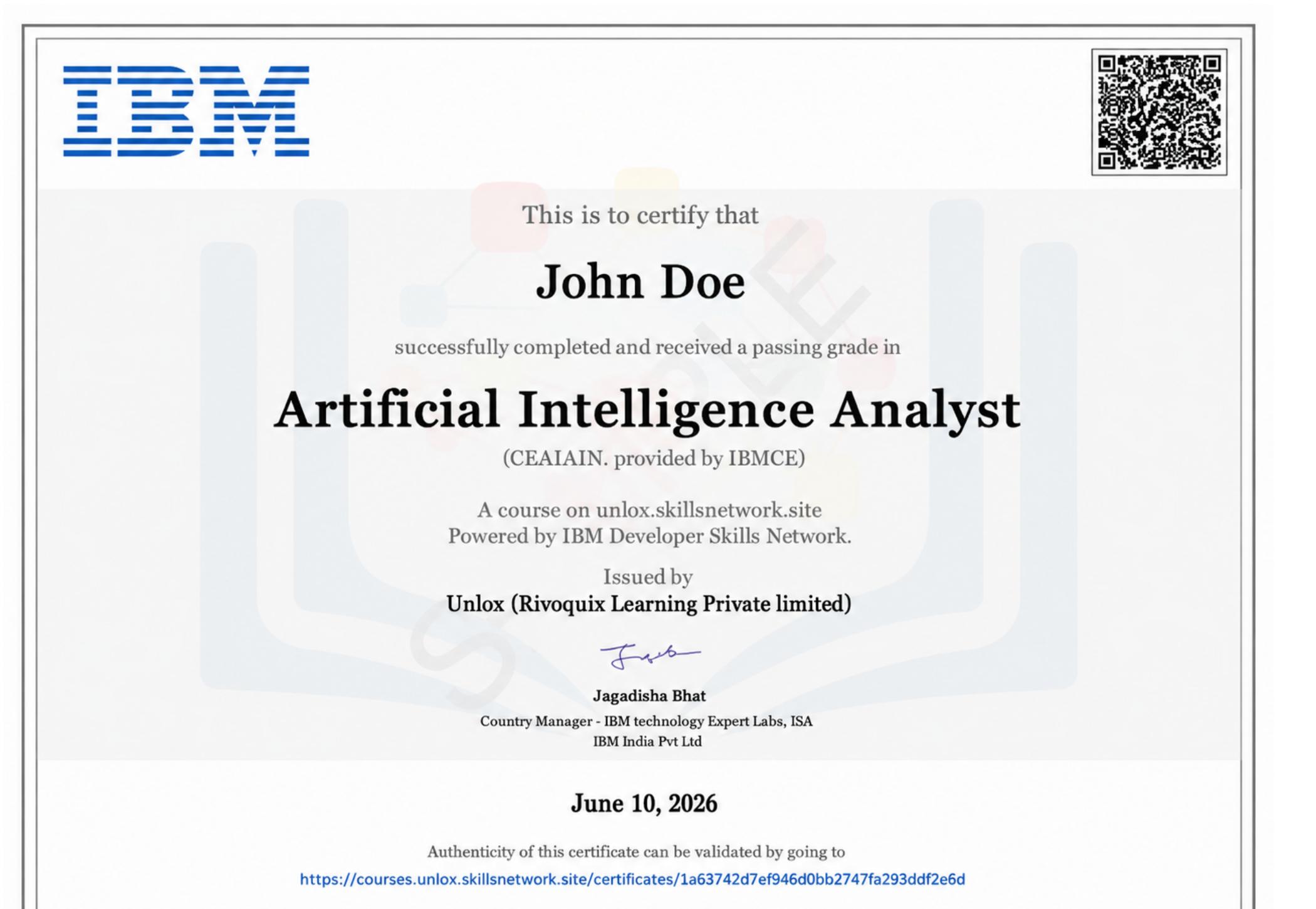
Sample credential shown for illustration. Learner name, project title and verification link are unique to each issued certificate.
IBM learning experience component
Issued on unlox.skillsnetwork.site, powered by IBM Developer Skills Network. Verifiable by QR and certificate URL.
Complete the included IBM learning experience component
Receive a passing grade on the course assessments
Transformation
Capability is the outcome — and it is visible in what you can build, review and defend at the end.
Before
01During
02After
03What exists at the end
Role explorer
Preparation here is capability-based: each role lists what you can actually do, and the project evidence that proves it.
Takes models from data to a measurable production service.
You can
Proven through
Portfolio evidence
Proof of work
Everything you build is packaged so a reviewer can evaluate it in minutes.
Models running behind a real interface or API, not notebook screenshots.
Industry ecosystem
Projects, reviews, career preparation and industry interactions connect what you learn to how work actually happens.
UNLOX / Industry ecosystem
LiveCompanies in the UNLOX hiring network
















Machine Learning Engineering
UNLOX Global Program
₹65,000
Shown for India · INR. Change your country in the header to see local pricing.
Scholarship opportunities may be available for eligible learners.
What you invest in
What you leave with
Global learner scholarship
Scholarship opportunities may be available for eligible learners joining selected UNLOX Global Program cohorts.
Scholarship eligibility may depend on learner profile and cohort availability.
Scholarship availability can vary between programs and intakes.
Eligible international applicants can request an assessment.
Scholarship availability, eligibility and award value are subject to program terms, learner profile and cohort availability.
FAQ
Yes. The program is open to international learners. Sessions are scheduled to work across major timezone groups, and every live session is recorded so you can catch up if a slot does not suit you.
Apply
Share your details and our team will connect with you about the Machine Learning Engineering program — live session schedule, 4-month structure, fees and the next intake.
Applications open · Global program
Join UNLOX Machine Learning Engineering and turn learning into projects, projects into proof, and proof into career readiness.
Machine Learning Engineering
UNLOX Global Program
Check your eligibility in 2 minutes.
Share a few details and our team reviews your profile, cohort fit and scholarship options before any commitment.
Reviewing applications from India · Asia / IST
More about this program
Applied machine learning engineering is the practice of turning data into working prediction systems. It covers preparing data, engineering features, training and comparing models, evaluating them honestly, explaining their behaviour and running them in production.
The job is less about knowing every algorithm name and more about being able to take a business problem, frame it as a learning task, build it, measure it, deploy it and explain why you built it that way.
The UNLOX Global Machine Learning Engineering program covers ML foundations, Python and statistics for ML, data preparation and feature engineering, regression and classification, imbalanced learning and anomaly detection, recommendation systems, computer vision, natural language processing, ensembles and explainability, and production ML and MLOps.
Each area is taught through building. Learning is verified by what you can produce, reviewed by mentors, and documented as portfolio evidence.
Learners target roles such as junior machine learning engineer, applied ML developer, computer vision associate, NLP/ML associate and MLOps associate. Each role expects evidence: deployed systems, evaluation records and the ability to defend technical decisions.
Every role you might target is backed by at least one machine learning system you built, evaluated and documented yourself.
Learning is project-based. You define the prediction target, prepare data and features, establish a baseline, train and compare models, evaluate, review, improve, deploy, monitor, document and publish. BLU AI support and human mentor review run alongside every stage.